Showing posts with label George Gershwin. Show all posts

Tuesday, November 15, 2011

Oh, Kay! The Confessional - Billie and Rosie

How would you feel if you kept getting pushed out of the way.  If the love of your life traipsed around with another woman (or two)!

That's what the ladies of today's confessional have to deal with.  Billie (portrayed Erica Kimble) and Rosie (portrayed by Kathryn Han) are two girls just looking for love.  Who's foiling their efforts? Find out in this installment of "The Confessional."

What's going on Girls?


Want to see if Billie or Rosie get their man... or any man? Enter our Gerswhin infused estate on the Hamptons with Oh, Kay! playing at the Eureka Theatre through Nov. 20, 2011.  Call (415) 255-8207 or purchase online at 42ndstmoon.org

Saturday, November 12, 2011

Oh, Kay! The Confessional - Constance Appelton

Today's confessional comes from none other than the new mistress of the Winter estate, Constance Appleton, portrayed by the lovely Lisa-Marie Newton.

How would you feel if you watched your former, but soon to be again, husband flirt with... the MAID!  Plus, you had to deal with the antics of a wily butler with no manners who hardly knows how to serve a proper Hamptons' lunch.

And all of this in front of her sainted father, the Judge!

Tell us how you really feel Constance.


Want to see the whole story? Come see a world of flappers, bootleggers, jazz, and mistaken polygamy?!? It's George and Ira Gershwin's Oh, Kay! playing at the Eureka Theatre through Nov. 20, 2011.  Call (415) 255-8207 or purchase online at 42ndstmoon.org

Friday, November 11, 2011

Oh, Kay! The Confessional - Shorty McGee

Whenever I watch Reality Television... wait... did I just admit to watching Reality Television?  Oh well, the cat's out of the bag.

Anyway... I find myself waiting for those short "interview - confessionals".  You know the snippets where you get to hear all the snarky comments the contestants, housemates, coworkers, etc. make about each other?

I wondered what would those confessionals sound like in 1927, so I asked some of the members of the cast of Oh, Kay! if they would help me create some of these confessionals.

Here is "Shorty McGee" played magnificently by Brian Yates Sharber... let's see what Shorty has to say:


Check out Shorty McGee and all the wacky characters in the world of George and Ira Gershwin's Oh, Kay! playing at the Eureka Theatre through Nov. 20, 2011.  Call (415) 255-8207 or purchase online at 42ndstmoon.org

Monday, October 31, 2011

Oh, Kay! and the Langauge of a Musical


Hey all you Moon birds.  I was watching a rehearsal of Oh, Kay! and realized I don’t know from nothin’ about some of the swell language used by P. G. Wodehouse, Guy Bolton and Ira Gershwin in the show.  I had to go a searchin’ and came across this swell website which listed all these terms; it was the bees knees and that’s no Banana Oil!

So here you go… here are some of the slang terms used in the 20’s and 30’s.  All of the terms that have been bolded are ones that you’re sure to hear in Oh, Kay!, which is playing at the Eurkea Theatre from Nov 2 to Nov 20, 2011.  For more information click here.  For tickets call (415) 255 -8207 Tuesday through Friday, noon to 5pm, or click here.

A
Abe's Cabe: five-dollar bill
ace: one-dollar bill
all wet: incorrect
And how!: I strongly agree!
apple sauce: flattery, nonsense, i.e.. "Aw, applesauce!"

B
baby: sweetheart; also denotes something of high value or respect
baby grand: heavily built man
baby vamp: an attractive or popular female; student
Banana Oil: Insincere flattery; nonsensical exaggeration
Bank's closed.: no kissing or making out ie. "Sorry, mac, bank's closed."
barrelhouse: illegal distillery
beat it: scram, get lost
beat one's gums: idle chatter
bee's knee's: terrific; a fad expression.
beef: a complaint or to complain
beeswax: business; student
belt: a drink of liquor
bent: drunk
big cheese: important person
bird: general term for a man or woman, sometimes meaning "odd," i.e. "What a funny old bird."
blind: drunk
bootleg: illegal liquor
breezer (1925): a convertible car
brown: whiskey
brown plaid: Scotch whiskey
Buddy Poppy: artificial flower warn in support of the Veterans of Foreign Wars
bump off: to kill
bum's rush, the: ejection by force from an establishment
bunny (1925): a term of endearment applied to the lost, confused, etc; often coupled with "poor little"
Butt me.: I'll take a cigarette

C
caper: a criminal act or robbery
cat's meow: great, also "cat's pajamas" and "cat's whiskers"
cash: a kiss
Cash or check?: Do we kiss now or later?
check: kiss me later
chewing gum: double-speak, or ambiguous talk
clam: a dollar
coffin varnish: bootleg liquor, often poisonous
copacetic: excellent, all in order
crasher: a person who attends a party uninvited
cuddler: one who likes to make out

D
daddy: a young woman's boyfriend or lover, especially if he's rich
daddy-o: a term of address; strictly an African-American term
dapper: a Flapper's dad
deb: a debutant
dewdropper: a young man who sleeps all day and doesn't have a job
dick: a private investigator; coined around 1900, the term finds major recognition in the 20s
dogs: feet
doll: an attractive woman
dolled up: dressed up
don't know from nothing: doesn't have any information
don't take any wooden nickels: don't do anything stupid
dope: drugs, esp. cocaine or opium.
doublecross: to cheat, stab in the back
dough: money
drum: speakeasy
dry up: shut up, get lost
ducky: very good
dump: roadhouse

E
earful: enough
edge: intoxication, a buzz. i.e. "I've got an edge."
egg: a person who lives the big life
Ethel: an effeminate male.

F
a Flivver
face stretcher: an old woman trying to look young
fella: fellow. as common in its day as "man," "dude," or "guy" is today, i.e. "That John sure is a swell fella."
fire extinguisher: a chaperone
flapper:
A fashionable young woman intent on enjoying herself and flouting conventional standards of behavior.
flivver: a Model T; after 1928, could mean any broken down car
fly boy: a glamorous term for an aviator
four-flusher: a person who feigns wealth while mooching off others

fried: drunk

G
gams
gams (1930): legs
gasper: cigarette
Get Hot! Get Hot!: encouragement for a hot dancer doing his or her thing
get a wiggle on: get a move on, get going
get in a lather: get worked up, angry
giggle water: booze
gin mill: a seller of hard liquor; a cheap speakeasy
glad rags: "going out on the town" clothes
go chase yourself: get lost, scram.
goods, the: (1) the right material, or a person who has it (2) the facts, the truth, i.e. "Make sure the cops don't get the goods on you."
goof: (1) a stupid or bumbling person, (2) a boyfriend; flapper.
goofy: in love
grummy: depressed
grungy: envious

H
hair of the dog (1925): a shot of alcohol
handcuff: engagement ring
high hat: a snob
hip to the jive: cool, trendy
hit on all sixes: to perform 100 per cent; as "hitting on all six cylinders;" perhaps a more common variation in these days of four cylinder engines was "hit on all fours;" also see "big six".
hoary-eyed: drunk
hooch: booze
hood (late 20s): hoodlum
hooey: bullshit, nonsense; very popular from 1925 to 1930, used somewhat thereafter
hopped up: under the influence of drugs
horse linament: bootleg liquor

I
iron
"I have to go see a man about a dog.": "I've got to leave now," often meaning to go buy whiskey
icy mitt: rejection
insured: engaged
iron (1925): a motorcycle, among motorcycle enthusiasts
iron one’s shoelaces: to go to the restroom


J
Jitney
jack: money
Jake: great, i.e. "Everything's Jake."
Jalopy: a dumpy old car
Jane: any female
java: coffee
jeepers creepers: "Jesus Christ!"

jitney: a car employed as a private bus; fare was usually five cents, ergo the alternate nickname of "nickel"
joe: coffee
Joe Brooks: a perfectly dressed person; student
joint: establishment
jorum of skee: a drink of hard liquor
juice joint: a speakeasy


K
keen: appealing
killjoy: a solemn person
know one's onions: to know one's business or what one is talking about

L
left holding the bag: (1) to be cheated out of one's fair share (2) to be blamed for something
line: a false story, as in "to feed one a line"
live wire: a lively person
lollygagger: (1) a young man who enjoys making out (2) an idle person

M
a little moonshine, anyone?
manacle: wedding ring
mazuma: money
milquetoast (1924): a very timid person; from the comic book character Casper Milquetoast, a
mind your potatoes: mind your own business
moonshine: homemade whiskey
mop: a handkerchief
Mrs. Grundy: a prude or kill-joy
mulligan: Irish cop
munitions: face powder

N
neck: to kiss passionately; what would today be called "French kissing"
necker: a girl who wraps her arms around her boyfriend's neck
noodle juice: tea
nookie: sex
"Not so good!": "I personally disapprove."
"Now you're on the trolley!": "Now you've got it!".

O
old boy: a male term of address, used in conversation with other males as a way to denote acceptance in a social environment; also: "old man" or "old fruit"
Oliver Twist: a skilled dancer
on a toot: a drinking binge
on the lam: fleeing from police
on the level: legitimate, honest
on the up and up: on the level
orchid: an expensive item
ossified: drunk
owl: a person who's out late

P
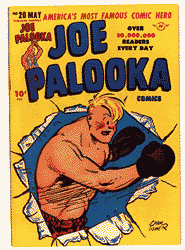
palooka: (1) a below-average or average boxer (2) a social outsider; from the comic strip character Joe Palooka, who came from humble ethnic roots
panic: to produce a big reaction from one's audience
petting pantry: movie theater
phonus balonus: nonsense
piffle: baloney
pill: (1) a teacher (2) an unlikable person (3) cigarette
pinch: to arrest
pinko: liberal
pipe down: stop talking
putting on the ritz: after the Ritz Hotel in Paris (and its namesake Caesar Ritz); doing something in high style; also, "ritzy"

R
rag-a-muffin: a dirty or disheveled individual
razz: to make fun of
Real McCoy: a genuine item
regular: normal, typical, average
Reuben: an unsophisticated country bumpkin; also, "rube"
Rhatz!: "How disappointing!" flapper
rotgut: bootleg liquor
rummy: a drunken bum

S
Speakeasy
sap: a fool, an idiot; very common term in the 20s
sawbuck: ten-dollar bill
says you: a reaction of disbelief
scratch: money
sheba: one's girlfriend
sheik: one's boyfriend
shine box: a bar or club for black patrons
simolean: a dollar
sinker: a doughnut
skee: Scotch whiskey
skirt: an attractive female
smarty: a cute flapper
smudger: a close dancer
snort: a drink of liquor
so's your old man: a reply of irritation
speakeasy: a bar selling illeagal liquor
spill: to talk
splifficated: drunk
spoon: to neck, or at least talk of love
static: (1) empty talk (2) conflicting opinion
stilts: legs
stuck on: in love; student.
swanky: (1) good (2) elegant
swell: (1) good (2) a high class person

T
take someone for a ride: to take someone to a deserted location and murder them
tasty: appealing
tea: marijuana
tell it to Sweeney: tell it to someone who'll believe it
three-letter man: homosexual
tight: attractive
tomato: a "ripe" female
torpedo: a hired thug or hit-man
trip for biscuits: wild goose chase

U
unreal: special
upstage: snobby

V
Pola Negri- Actress and Vamp
vamp: (1) a seducer of men, an aggressive flirt (2) to seduce
voot: money

W
water-proof: a face that doesn't require make-up
wet blanket: see Killjoy
white lightning: bootleg liquor
wife: dorm roommate; student.
"What's eating you?": "What's wrong?"
whoopee: wild fun

Y
"You slay me!": "That's funny!"

Z
zozzled: drunk

Sunday, March 27, 2011

The Mystery of George Spelvin

I received a call from a longtime patron of ours the other day, a representative of George Spelvin. She wanted to renew his subscription for the upcoming 2011-12 season.

Now, this probably doesn’t seem odd, but I was in the middle of reading a scene, from Strike Up the Band, between George Spelvin and Horace J. Fletcher.

“What an odd coincidence,” I thought.

George Spelvin
Do you know who George Spelvin is? He is a man of particular mystery in the Kaufman script. And here he has a representative calling on his behalf, somewhat mysterious in and of itself.

I began to do a little digging (not hard with Google and Wikipedia) and discovered what many of you may already know, but just in case you don’t….

George Spelvin is 125 years old. He has been in more plays than any other actor in history. Most importantly… he doesn’t exist.

It is a pseudonym used in the theatre (mostly American) for a number of reasons, but generally always to stand in for the name of an actor.
Spelvin has stood in for actors playing dual roles; union actors wishing to remain anonymous when performing in non-union theaters; and often when there is literally no actor at all. For instance, when the director doesn’t want the audience to know a character will not actually appear on stage, such as in a mystery or melodrama. I’m sure there has been a production or two of Harvey, where Harvey is played by George Spelvin.

He has also appeared as the name of a character in Strike Up the Band, Christopher Durang’s The Actor’s Nightmare, in an episode of Fibber McGee and Molly, and the I Love Lucy episode, “Don Juan is Shelved.”

Benjamin Knoll
Spelvin comes from an illustrious family that also includes, Alan Smithee (cousin according to the IMDB), and his English relatives Walter Plinge and David Agnew. Can you tell me who these gentlemen are?

Do you have any favorite pseudonyms? Do you have a pseudonym that you have ever used?

Oh, and to find out why our George Spelvin, played by the devilishly charming Benjamin Knoll, is so mysterious, come to the Eureka Theatre April 6-24 for George & Ira Gershwin and George S. Kaufman’s Strike Up the Band. For tickets click here or call (415) 255 -8207.

Sunday, April 4, 2010

The Reviews Are In

We asked our opening night audience, if anyone wanted to write a review.  We did not offer free tickets; we did not solicit specific “Moonies”, it was completely open to anyone who wanted to try their hand at some reviews.  We had some eager takers!  I promised I wouldn't edit them at all... so here they are.  Direct from the audience members.  I did add the titles, however.


BLOWN AWAY

I expected to enjoy Lady, Be Good! I did not expect to be virtually blown away by the talented and consistently spot-on cast! Every cell in my body wanted to move with the piano “overture,” (few understand what it takes to solo-piano accompany a musical such as this—Gershwin’s music is tricky and often demanding. The pianist was a delight and I’ll take “live” over “canned” any day).

Ian Simpson’s voice (Dick Trevor) is a joy to listen to and he is a pleasure to watch. What a winning smile! Rena Wilson’s facial expressions (Susie Trevor) enhance her exquisite singing and dancing. Her energy floats out into the audience and grabs you. Andrew Boyer (Watty Watkins) produced some of the best comedic timing I’ve seen in a long while. Comedy is hard to do and he does it well! His scenes with [Ben] Knoll (Bertie Bassett) are priceless—Laurel-and Hardy-quality.

Reviewers often think that in order to be erudite and credible they need to concentrate on flaws, on what they didn’t like. On opening night there are usually a few missteps. If so, I missed them. Yes, the second act started out rather “slow,” but that may have been simply because the first act was so “fast.” I’m sure it will tighten up as the show progresses. What I didn’t like? It was over too soon! My brain’s opinion is colored by my love of Gershwin, piano music, and dance. Nevertheless, do not walk, run, to catch Lady, Be Good! This was my first visit to the Eureka Theatre. I’ll definitely be back!

- ARLENE R. TAYLOR, PhD is one of the world's leading speakers on brain function, is sometimes referred to as the brain guru. Taylor has spoken to thousands of people at conferences internationally. She is a sought-after charismatic speaker who presents practical brain function information in entertaining, educational, and empowering ways.


DELIGHTFUL NIGHT AT THE THEATER

The theater crowd was in an especially happy mood last night at the opening of Lady, Be Good!, now showing at San Francisco's Eureka Theatre where the 42nd Street Moon Theatre Company re-creates Broadway hit musicals of the 1920s and 1930s. The audience was full of smiling, toe-tapping customers.

In the lobby you could hear the buzz, the murmurs and humming of the crowd: “This is the best one yet;”  "AMAZING ACTING;” “Just really fabulous music, dancing, and singing;” “Didn't you just want to jump up and dance with them?;” “That song 'Fascinating Rhythm' always was my favorite” “We sang that song('You Don't Know the Half of it Dearie blues') as part of our college chorus and we were a hit in front of the Princeton Nassoons."

Ian Simpson and Rena Wilson, in the leading roles first played by Fred Astaire and his sister Adele Astaire back in 1924, just sparkled and connected with the 2010 audience, eager for some reason to laugh and an expectation of happy endings!

Dave Dobrusky, at the piano, is adored by all and never disappoints, bringing new fans to musicals with his confident mastery and personable versions of every classic melody!

Noel Anthony brought sincere romance and masculine strength with gentility to the stage.

Nicholas Yenson's solo number, “Little Jazz Bird” was so sophisticated and beautiful, the crowd was at first speechless, then boisterous in their approval.

You can't find a more delightful night at the theater.

Step back in time. Rush to experience theater at its best.

42nd Street Moon's 1924 musical production of Lady, Be Good! has it all: Ira and George Gershwin's sophistication, rhythm and sheer sassy joy, some of the best acting, dancing, singing, piano playing, choreography and costumes you'll ever have a happy chance to enjoy!

Transport yourself and your friends to the campy, joyous “living large” time of the 1920s.

Lady, Be Good is not just good; it is truly great!

 - JANET BEACH


A BRAIN'S OPINION

In my brain’s opinion do not walk—run to catch this performance. The songs are Gershwin gems. The catchy score found me tapping my toes and every cell in by body humming a Gershwin tune long after the players have taken their well deserved bow.

The cast is fabulous. Just fabulous. Ian Simpson and Rena Wilson sing, act, and dance the roles originally played by the Astaire’s and are just delightful to watch. Their dances are extraordinary, from the tapping to the Charleston to the dancing on the couch. The other standout performer is Andrew Boyer as Watty Watkins, who does an amazing job providing comic relief as the meddling lawyer. The scenes with Boyer and Knoll are priceless. This production is a parade of pulsing talent. This was my first visit to the Eureka Theatre. I’ll definitely be back!

- SHARLET M. BRIGGS, PhD, is an internationally renowned author and speaker in the field of brain function, self development and memory. She is the author of over 8 books, has created many videos, and has appeared on radio shows.
 
 
A REAL SHOW STOPPER
 
Last night, I and my companion, watched, with enjoyment, 42nd Street Moon’s version of the George and Ira Gershwins’s classic, Lady Be Good!

The whole ensemble was in sync with each other and the performance brought a delightful bit of nostalgia to my ears.

From the opening to the end, Dave Dobrusky’s piano playing carried ‘the tune of the show.’ As it does every musical performance, that I have seen, by 42nd Street Moon.

At first I felt that Rene Wilson, playing the role of Susie Trevor, was carrying the show with her singing and dancing.

Then I thought that it was Andrew Boyer, playing lawyer Watty Watkis, was carrying the show. When he sang “Oh Lady be Good”.

But at the end, I thought Nicholas Yenson was the show “show stopper” when he sang and danced the “The Little Jazz Bird” tune.

But, when they were all taking their bows, I realized that the singing and dancing performances, of the
entire cast, were the “show stopper” and they all carried the show!

If I were a Chronicle critic, I would give it a “clapper”

- ROLAND SHEPPARD is an amateur critic from New Jersey, his went to his first broadway show in 1961 to see Destry Rides Again, "It is good to be back on 42nd Street!"


I'm back.  Don't miss your chance to see, what the most important critics - the audience - are raving about!  42nd Street Moon's production of the Gershwins' Lady, Be Good! now through April 18 at the Eureka Theater.

For tickets call (415) 255-8207 or click here.

Tuesday, March 30, 2010

Lady, Be Good! In Context

With the exception of a few very notable shows, most of the names of the Gershwins’ musicals have become forgotten to the vast majority of Americans, but the songs that came from these shows are as ingrained in our collective knowledge as the advertising slogans “Just Do It” or “Reach Out and Touch Someone.” Take our current offering, Lady, Be Good! I have to admit, I wasn’t familiar with the title before we started to produce it… but “Fascinating Rhythm”?  Well, I have 13 versions of it on my i-Pod. 


This is what I love more about Moon than anything else.  I don’t just have the opportunity to listen to “Fascinating Rhythm”, but I get the chance to understand WHY it was written.  This was made ever so clear during our run of Call Me Madam.  Watching Klea Blackhurst and Charlie Levy complete the entire scene that included “You're Just In Love” brought a meaning to that song I never had before: the original intention.

With each new production here at Moon, I look forward to understanding the original emotions and motivations behind some of my favorite songs.  That is not to say that I won’t still enjoy my Ella Fitzgerald Songbook, on the contrary, I’ll enjoy them even more.

Are you sure you really understand “Fascinating Rhythm”?  If not, come see 42nd Street Moon’s Lady, Be Good! at the Eureka Theater.  Previews start March 31, for tickets call (415) 255-8207 or click here to buy online and avoid a box office fee. 


– Update March 31st is SOLD OUT.  There are a few seats remaing April 1 - 4, but best seating is available April 7-17.

Wednesday, March 24, 2010

It's the Last Midnight...

Ok, I don’t usually write JUST about buy tickets or subscriptions, so I’m gonna make this one REALLY short.  If you aren’t already a subscriber, than you probably don’t know that you can subscribe for next season already.  Well, my lucky Bloggees, as a special treat for you, for following me… you can subscribe online RIGHT NOW and get our special Early Bird prices that are usually reserved for current subscribers.

So whatcha waiting for, with a season of Sondheim (Happy Birthday!), Rodgers and Hart, Cole Porter, the Gershwins, and our first ever NEW WORK!  Get it at the lowest possible price and receive all those killer benefits like no box office fees, retaining your favorite seats year after year, and most important the knowledge that you are supporting 42nd Street Moon.  The deadline is tomorrow March 25th, 2010 at, yup, you guest it... Midnight!

Thursday, January 28, 2010

Ira Gershwin Facts: Our Love Is Here To Stay

Ira Gershwin was simply one of the best lyricists that has ever written for the stage.  His words… urbane, his rhymes… clever, and he literally created new ways to use language in song.  His legacy lives on in the expressions he chose to set to music.


In his lifetime, those words brought him many honors, including the highest of American literary awards: The Pulitzer Prize for Drama.  Ira was the first lyricist deemed worthy enough to win the honor along with his “book” cohorts George S. Kaufman and Morrie Ryskind for the musical Of Thee I Sing. 
Unfortunately, the Tony Awards didn’t really come about until after Ira left New York for California.  However, he was also nominated for three Oscars for his work in Hollywood.  Interestingly, each of Ira’s nominations was crafted from songs written by different composers: “They Can’t Take That Away From Me” (music by George Gershwin, 1937), “Long Ago and Far Away” (music by Jerome Kern, 1944), and “The Man that Got Away” (music by Harold Arlen, 1954).
Also in LA, George and Ira re-wrote a version of “Strike Up the Band” for UCLA in 1936.  As a Bruin myself, I would like to humbly thank the Gershwins!  I would also like to chide UCLA for no longer using the song.  However, in appreciation UCLA created the George and Ira Gershwin Lifetime Musical Achievement Award.  Past winners have included Angela Lansbury, Ray Charles, Frank Sinatra, Burt Bacharach, and Julie Andrews.


In 1992, Ira would contribute lyrics to a Tony Award-winning show with Crazy For You, a major reworking of Girl Crazy.
In 1973, the Post Office issued an 8-cent postage stamp to honor the Gershwins in the American Art series.


In 1985, they were awarded a Congressional Gold Medal “to honor their contribution to the American Spirit.”
In 1998, the Pultizer committee finally rectified the error they had made to George with a posthumous special Pulitzer Prize to them both, awarded on the centennial of his brother's birth. 
The Library of Congress has named its Prize for Popular Song after the brothers; the award began in 2007. 
I could go on, but I won’t.  Suffice it to say our fascination with Ira Gershwin, and his brother, will live on.  They can’t take that away from me… or you.  Come celebrate Ira’s legacy with us at Nice Work If You Can Get It: An Ira Gershwin Salon, at the Alcazar Theater, 7PM tonight.  For tickets click here, or call (415) 255-8207. 

Wednesday, January 27, 2010

Ira Gershwin Facts: Back Home

Ira was the oldest of Morris and Rose’s four children; he was two when George was born.  Arthur was their third child, and Frances was 10 years Ira’s junior.  In fact she was exactly 10 years younger -- they shared the same birthday.
Ira has been called the “quiet Gershwin,” but this was never because he was pushed to the side. He preferred to eschew the limelight, choosing instead to observe the world around him.
 All the better to comment on life, love, and the world through his lyrics, wouldn’t you say?
Growing up he helped with the family and the family businesses, at one point working as a cashier at his father's Turkish Baths.  When he and George became creative partners, Ira took control of the brothers’ financial interests.  In fact he has been quoted as saying, "I always felt that if George hadn't been my brother and pushed me, I'd have been contented to be a bookkeeper."
On September 14, 1926, Ira Gershwin and Leonore Strunsky were married. As Ira and George became successful, they moved their entire family to a beautiful five-story house at 316 West 103rd Street in Manhattan. Ira and Leonore took the fourth floor, but the house was always bustling with visitors.
Two years later, George and Ira would move to adjoining penthouses on Riverside and 75th (where they auditioned Ethel Merman).
Ira even vacationed with his family.  The same year of the move to Riverside, Ira, his wife, George and Frances went on holiday to Europe, traveling through London, Vienna, and Paris.  The result?  George Gershwin’s An American in Paris.


Ira’s beloved wife, Leonore, passed away in 1991.  We are honored her nephew, Michael Strunsky and his wife, Jean, are joining us for Nice Work If You Can Get It: An Ira Gershwin Salon.  The show starts at 7pm, Thursday, January 28, 2010 at the Alcazar Theater.  If you’d like to join us, please click here or call (415) 255-8297.
(photos from top to bottom: Arthur Gershwin; Leopold Godowsky and Frances Gershwin Godowsky; George and Rose Gershwin; Jean Strunsky, Artistic Director Greg MacKellan, Michael Strunsky, Donna McKecknie)

Tuesday, January 26, 2010

Ira Gershwin Facts: A Star Is Born

The Gershwins knew talent.
In 1916, George had met a young man looking for a song for his and his sister’s vaudeville act.  Though they did not work together at the time, they vowed they would.  In 1922, they got their first chance with For Goodness Sake.  George and Ira aided the production with two songs, and Ira helped with lyrics to a third.  The show starred the young man and his sister, Fred and Adele Astaire.  The Astaires would later star in the Gershwin’s first Broadway show Lady, Be Good! and their smash Funny Face.
In 1926, they gave Gertrude Lawrence her first Broadway book musical, with Oh, Kay!

Then in 1930, a young Ethel Merman was whisked away to the Gershwin’s apartment at 33 Riverside Drive to audition for their newest musical, Girl Crazy.  After her audition, George offered to play a few songs from Girl Crazy.
Gershwin mistook Merman’s quiet contemplation of the songs as disapproval.  After playing “I Got Rhythm,” George replied to Merman’s silence, "If there’s anything about these songs you don’t like, Miss Merman, I’ll be happy to make changes."


The fog lifted, the magnitude of Merman’s situation hit her, and she replied, "They will do very nicely, Mr. Gershwin." Though Merman’s response was made out of frightened intimidation given her current situation, her almost blasé response helped fashion her reputation as the sassy belter for which we would come to know her.

These were stars that both George and Ira helped usher into the hearts of the American public. However, much later in life Ira would become a mentor to another young singer.  In July 1977, at age 20, Michael Feinstein became Ira’s assistant for six years.  Since that mentorship, Feinstein has become one of the greatest interpreters of the Gershwin’s work and a staunch advocate to preserving the Great American Songbook.

Ira Gershwin met and made his share of stars.  To see our biggest star of the year, Tony Award Winner and Broadway legend Donna McKechnie, come to 42nd Street Moon’s Nice Work If You Can Get It: An Ira Gershwin Salon, this Thursday, January 28, 2010 at the Alcazar Theater.  For tickets click here, or call (415) 255-8207.

(photo: Fred Astaire, George, Ira)