Monday, May 10, 2010

Very Warm for May: A Musical Analysis


Robbie Cowan is a performer, musician, coach, director, and liturgist. He has worked with Moon many times in the past and is a recent graduate of the San Francisco Conservatory of Music, where hereceived his Masters in Music with honors in voice and musical theatre in May of 2009.  Robbie asked to write a guest blog in which analyzes the music of Very Warm for May, the second half of the post does get a bit technical (you musicians and singers out there are gonna love it!), but I still found it fascinating.  Please enjoy!

“All The Things You Are” is nearly universally recognized as the greatest song in the musical theatre canon. Stephen Sondheim, who first saw Very Warm for May at age 9, cites it as his inspiration to begin a career as composer. Jazz legend has it that auditioners for the Miles Davis band were asked to play the song (from memory, of course) in non-standard keys picked randomly on the spot by Davis, himself. It is also frequently mentioned by composers as the one song that they wish they could have written.

One song does not a musical make, though, and this great praise for one number often overshadows an otherwise completely remarkable score. For instance, “In the Heart of the Dark” is another particularly striking song.

Both are moving ballads; both are similar in tempo and style, but these two pieces have interesting dissimilarities as well.


Lyrically, “Things” is an effervescent declaration of love, “the dearest things I know are what you are.”

“Dark” is a short narrative about fleeting romance, “the sun's on its way to steal my dreams. I know that you will fade in the light, and all I can do is wait for the night.” One song is a broad statement, the other a quiet contemplation.

Melodically, too, the songs are markedly dissimilar. “Things” is characterized by a leaping line, covering a vocally demanding 12 note range. It never moves in scalar motion [moving from one note to another in consecutive 1/4 or 1/2 steps] for more than a few notes, preferring instead an energetic rise and fall. Dark dwells on single notes for entire phrases and moves in half-step motion for most of the refrain.

Perhaps most interesting is the differences in harmonic structure.

In “Things,” the verse begins with a progression reminiscent of the high romanticism of Tchaikovsky or Chopin. Once we begin the main theme, though, we are taken through whirlwind modulations which never allow us to settle into a firm tonal center until the very last cadence.
This harmonic progression is not haphazard; it is very well plotted along the circle of fifths, landing briefly on certain chords only to quickly recontextualize them within the harmonic structure. This avoidance of a tonal center perhaps plays on the lyrical intent; the song represents a dizzy, leaping, adoring sort of love.

“Heart of the Dark's” frequent utilization of pedal tones in the verse seems to imply a very different message. The lyrics in this verse speak to waiting, and the pedal serves to reinforce that feeling. In the chorus we find ourselves firmly entrenched in a tonal center, and the harmonic structure favors stepwise motion to the circle of fifths.

This type of motion seems to suggest a static sort of yearning, as the lyrics indicate, a waiting for the dark.

At one point my character [Raymond Sibley - the young composer] mentions that he is looking forward to hearing the song performed, and I can say that I share this sentiment in real life, too. For all of the merits of “All The Things You Are," there is something about the simplistic melancholy of “Dark” that I find heartbreakingly beautiful. Sung by Alex Kaprielian [Miss Wasserman], whose beauty is only matched by her golden voice, this song near the end of the show is really a remarkable musical moment.

Pay close attention to the entrance of the chorus in rich eight part harmony and the extended final cadence.

Having long been familiar with "All the Things," I was amazed to find another remarkable song in this score, and thanks to Moon for making those discoveries possible!

-  Robbie Cowan

Monday, May 3, 2010

Do You Hear that Singing?

Before a rehearsal the other day, I was talking to Bill Fahrner and found out some interesting things about our upcoming production of Very Warm for May.

Often times at
42nd Street Moon we work with very limited "source" material.  A script and piano/vocal score are our creative team's usual tools. Rarely do the shows we produce include dance notations (unlike shows that were chorographed by Jerome Robbins, which almost always come complete with choreography), orchestrations, or even vocal arrangements.

Many times, like in Lady, Be Good!, those gorgeous vocal orchestrations come from our very own Musical Directors.  Notably, Dave Dobrusky has created some absolutely gorgeous vocal arrangments for our productions. Think about what you heard during "Little Jazz Bird;" they didn't hear that on Broadway!

However, Bill let me on to a bit of trivia!  Very Warm for May came complete with a number of original arrangments from 1939.  Those of you coming to the Eureka in the next three weeks will be in for a treat: The original (and unique) vocal arrangement for one of
Jerome Kern's greatest hits, "All the Things You Are," and a number of Kern songs that have never been recorded!

Come to Very Warm for May at the Eureka Theater, May 5-23. For tickets call (415) 255-8207 or
click here.

Wednesday, April 28, 2010

Beyond the Cotton Blossom: Kern and Hammerstein

This is a guest blog from former Oakland Tribune Theater Critic Robert Taylor:

Show Boat may have been a turning point in the American musical theater, and in the careers of composer Jerome Kern and lyricist Oscar Hammerstein II, but it was not the only show they created.

Kern worked with many, lyricists during his 40-year stage and screen career, among them Dorothy Fields, Ira Gershwin and Johnny Mercer. So the partnership Kern and Hammerstein doesn’t pop up in the memory as easily as Rodgers and Hammerstein, Lerner and Loewe, or Kander and Ebb.

In fact, Hammerstein and Kern created seven musicals—just two fewer than Hammerstein wrote with Richard Rodgers. But only five of those reached New York, and only four were hits. Still, even the nearly forgotten Sweet Adeline was one of the hottest tickets on Broadway before the 1929 stock market crash. And Very Warm for May, which ran for only 59 performances in 1939, introduced “All the Things You Are.”   Even rival Broadway composers have described "All the Things You Are" as the greatest song ever written.

Kern had a 15-year head start in the theater when he paired with Hammerstein (and Otto Harbach) for their first show, Sunny, in 1925. It was a vehicle for dancing star Marilyn Miller (following her Sally of 1920), but it brought out the best in the new partners. “They worked together as if born for this collaboration,” notes Hammerstein’s biographer Hugh Fordin. The show’s long-lasting hit song was “Who?”

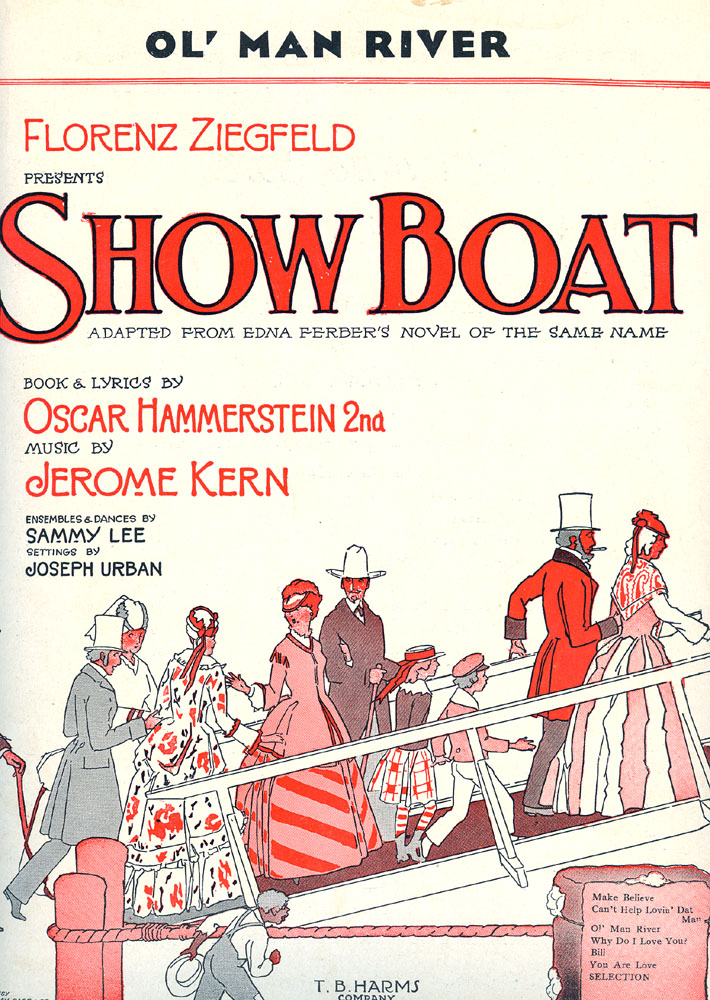
Kern was immediately attracted to Edna Ferber’s best-selling novel Show Boat for their next collaboration in 1927, and Hammerstein needed no persuading. Theater historian Gerald Bordman still considers the landmark show the high point in Kern and Hammerstein’s careers, yet some of the critics left their names out of their reviews, lauding the show’s arrival as a Florenz Ziegfeld production.

Another theater historian, William Zinsser, claims that after Show Boat, Kern “went right back to composing Viennese-style musicals.” But his melodies continued to soar. Sweet Adeline, his third show with Hammerstein, re-created the Gay ’90s with “Spring is Here” and Helen Morgan introducing “Why Was I Born?”

Kern and Hammerstein’s Music in the Air, in 1932, was an operetta at first glance, set in Bavaria, but some critics considered it as revolutionary as Show Boat for merging book and score. “The Song is You” and “I’ve told Every Little Star”—a tune based on a birdcall Kern heard in Nantucket—became standards.

The hit songs, the standards, kept coming, but that was the end of the hit shows for the partnership as Kern settled comfortably in Beverly Hills to write for Hollywood musicals.

Kern’s cross-country shuttle was interrupted by their collaboration on Three Sisters, which ran 72 performances in London (introducing “I Won’t Dance,” which became a hit after it was used in the film Roberta.)  Their Gentlemen Unafraid, set at West Point during the Civil War, got a tryout at the St. Louis Municipal Opera in 1938 but got no farther. One song, “Your Dream,” ended up in the movie One Night in the Tropics, a 1940 Abbott and Costello vehicle.


Very Warm for May got them back on Broadway in 1939, if briefly. The musical’s problems have generally been blamed on producer Max Gordon and director Vincente Minnelli, who urged Hammerstein to strip down a book that had won applause in its out-of-town tryout. At least the cast was intact—among them Eve Arden, Avon Long, and in smaller roles, June Allyson and Vera Ellen.

Although a review’s headline called Very Warm for May “not so hot for November,” the final Kern-Hammerstein collaboration lives on. It was revived in New York by Equity Library Theater in 1985 and in a concert performance in 1994, as well as by 42nd Street Moon in 1995.

Who wouldn’t want to hear that Jerome Kern score again, if only for “All the Things You Are”? It’s one of his and Hammerstein’s most indelible songs, yet Kern didn’t think it would be a hit because it was so complicated melodically.

It’s the most perfectly constructed of all popular standards, says William Zinsser in Easy to Remember: The Great American Songwriters and Their Songs. “Kern effortlessly moves through five keys in 32 bars without breaking a sweat.”

“All the Things You Are” has no end of champions, including singer and pianist Max Morath, who calls it “a superb standard” but challenging “with a 12-note range likely to mortify most singers.” And it was composer Arthur Schwartz who called it “the greatest song ever written.”

Thank you again to Robert Taylor for this guest blog.  For your chance to hear Jerome Kern's original vocal arrangement of "All the Things You Are," come see Very Warm for May at the Eureka Theater running May 5-23.  For tickets call (415) 255-8207 or buy online.

Thursday, April 22, 2010

Three Sisters: A Restoration

I am thrilled to announce (and scoup all the news agencies!) that 42nd Street Moon, Artistic Director Greg MacKellan, and Musical Director Dave Dobrusky have received a 2010 NEA Grant for $25,000.

The grant is being awarded to restore the script and score of Jerome Kern and Oscar Hammerstein's lost work Three Sisters. In 1995, Moon put together a concert reading of Three Sisters. Although it was minimally staged, and the script was a skeletal narrative of the show, Variety acknowledged the glory of Kern’s score, “But the prize here is Kern’s extant music. This material was ideal for his way with a wistful ballad, and several are gorgeous…” Of the script, Variety noted, “This drama-with-songs seems more in line with the fabled team’s earlier Show Boat than their more frivolous ‘30’s vehicles.”


Artistic Director Greg MacKellan intends to go back to the original source material and re-store and construct a working production script. The basis of our 1995 score consisted of several songs with published sheet music, some piano selections published in England, and some transcriptions from a cast recording. Musical Director Dave Dobrusky will finish the score restoration and create a new, readable piano-vocal score as well as new chamber orchestrations for piano, woodwinds, and strings to present the score.

From our original concert press release:

Not based on Chekhov's work, this Three Sisters follows three very different siblings through their romantic adventures during the first two decades of the century. The three girls hold different marital aspirations, with the eldest sister, a great galumphing girl named Tiny, in love with a sturdy constable; Dorrie, the middle child dreaming of marriage to a wealthy man; and the youngest, Mary, smitten by a young busker named Gypsy Hood. Marriages, mistaken identities and World War I ensue, with the girls' hapless photographer father trying to manage it all.


Premiering April 9, 1934 at the Drury Lane Theater in London, Three Sisters was mounted with the intention of bringing it to the states after a successful London run, but mixed reviews closed the show after two months -- at the time, the shortest run in the history of the Drury Lane Theater. Kern had worked previously in London with great success. Shows such as Cabaret Girl, Beauty Prize and Blue Eyes, written with British lyricists and book writers such as P.G. Wodehouse, had been very well received by London critics and audiences alike. "Three Sisters was Kern's first production in London that was written with another American, Oscar Hammerstein, who wrote the lyrics and book," says 42nd St. Moon producer Greg MacKellan. According to MacKellan, "New York critics who traveled to London to see the show adored it, but London critics were less enthusiastic -- perhaps offended that two Americans would dare to write a musical with British characters and a British story." While David Fairweather of the U.S. magazine Theatre World wrote, "It is difficult to account for the failure of Three Sisters, for it is a charming, original production with by far the best music of any light opera within recent history," British critic W.A. Darlington sniffed "the music...is pleasant and cleverly handled, but not original."

I know I speak for everyone here when I say Congratulations to Greg and Dave and how excited we are to see the American Premiere production of a Jerome Kern and Oscar Hammerstein show!

Three Sisters will be part of Moon's 2011-2012 season. To subscribe for next season click here.

Sunday, April 4, 2010

The Reviews Are In

We asked our opening night audience, if anyone wanted to write a review.  We did not offer free tickets; we did not solicit specific “Moonies”, it was completely open to anyone who wanted to try their hand at some reviews.  We had some eager takers!  I promised I wouldn't edit them at all... so here they are.  Direct from the audience members.  I did add the titles, however.


BLOWN AWAY

I expected to enjoy Lady, Be Good! I did not expect to be virtually blown away by the talented and consistently spot-on cast! Every cell in my body wanted to move with the piano “overture,” (few understand what it takes to solo-piano accompany a musical such as this—Gershwin’s music is tricky and often demanding. The pianist was a delight and I’ll take “live” over “canned” any day).

Ian Simpson’s voice (Dick Trevor) is a joy to listen to and he is a pleasure to watch. What a winning smile! Rena Wilson’s facial expressions (Susie Trevor) enhance her exquisite singing and dancing. Her energy floats out into the audience and grabs you. Andrew Boyer (Watty Watkins) produced some of the best comedic timing I’ve seen in a long while. Comedy is hard to do and he does it well! His scenes with [Ben] Knoll (Bertie Bassett) are priceless—Laurel-and Hardy-quality.

Reviewers often think that in order to be erudite and credible they need to concentrate on flaws, on what they didn’t like. On opening night there are usually a few missteps. If so, I missed them. Yes, the second act started out rather “slow,” but that may have been simply because the first act was so “fast.” I’m sure it will tighten up as the show progresses. What I didn’t like? It was over too soon! My brain’s opinion is colored by my love of Gershwin, piano music, and dance. Nevertheless, do not walk, run, to catch Lady, Be Good! This was my first visit to the Eureka Theatre. I’ll definitely be back!

- ARLENE R. TAYLOR, PhD is one of the world's leading speakers on brain function, is sometimes referred to as the brain guru. Taylor has spoken to thousands of people at conferences internationally. She is a sought-after charismatic speaker who presents practical brain function information in entertaining, educational, and empowering ways.


DELIGHTFUL NIGHT AT THE THEATER

The theater crowd was in an especially happy mood last night at the opening of Lady, Be Good!, now showing at San Francisco's Eureka Theatre where the 42nd Street Moon Theatre Company re-creates Broadway hit musicals of the 1920s and 1930s. The audience was full of smiling, toe-tapping customers.

In the lobby you could hear the buzz, the murmurs and humming of the crowd: “This is the best one yet;”  "AMAZING ACTING;” “Just really fabulous music, dancing, and singing;” “Didn't you just want to jump up and dance with them?;” “That song 'Fascinating Rhythm' always was my favorite” “We sang that song('You Don't Know the Half of it Dearie blues') as part of our college chorus and we were a hit in front of the Princeton Nassoons."

Ian Simpson and Rena Wilson, in the leading roles first played by Fred Astaire and his sister Adele Astaire back in 1924, just sparkled and connected with the 2010 audience, eager for some reason to laugh and an expectation of happy endings!

Dave Dobrusky, at the piano, is adored by all and never disappoints, bringing new fans to musicals with his confident mastery and personable versions of every classic melody!

Noel Anthony brought sincere romance and masculine strength with gentility to the stage.

Nicholas Yenson's solo number, “Little Jazz Bird” was so sophisticated and beautiful, the crowd was at first speechless, then boisterous in their approval.

You can't find a more delightful night at the theater.

Step back in time. Rush to experience theater at its best.

42nd Street Moon's 1924 musical production of Lady, Be Good! has it all: Ira and George Gershwin's sophistication, rhythm and sheer sassy joy, some of the best acting, dancing, singing, piano playing, choreography and costumes you'll ever have a happy chance to enjoy!

Transport yourself and your friends to the campy, joyous “living large” time of the 1920s.

Lady, Be Good is not just good; it is truly great!

 - JANET BEACH


A BRAIN'S OPINION

In my brain’s opinion do not walk—run to catch this performance. The songs are Gershwin gems. The catchy score found me tapping my toes and every cell in by body humming a Gershwin tune long after the players have taken their well deserved bow.

The cast is fabulous. Just fabulous. Ian Simpson and Rena Wilson sing, act, and dance the roles originally played by the Astaire’s and are just delightful to watch. Their dances are extraordinary, from the tapping to the Charleston to the dancing on the couch. The other standout performer is Andrew Boyer as Watty Watkins, who does an amazing job providing comic relief as the meddling lawyer. The scenes with Boyer and Knoll are priceless. This production is a parade of pulsing talent. This was my first visit to the Eureka Theatre. I’ll definitely be back!

- SHARLET M. BRIGGS, PhD, is an internationally renowned author and speaker in the field of brain function, self development and memory. She is the author of over 8 books, has created many videos, and has appeared on radio shows.
 
 
A REAL SHOW STOPPER
 
Last night, I and my companion, watched, with enjoyment, 42nd Street Moon’s version of the George and Ira Gershwins’s classic, Lady Be Good!

The whole ensemble was in sync with each other and the performance brought a delightful bit of nostalgia to my ears.

From the opening to the end, Dave Dobrusky’s piano playing carried ‘the tune of the show.’ As it does every musical performance, that I have seen, by 42nd Street Moon.

At first I felt that Rene Wilson, playing the role of Susie Trevor, was carrying the show with her singing and dancing.

Then I thought that it was Andrew Boyer, playing lawyer Watty Watkis, was carrying the show. When he sang “Oh Lady be Good”.

But at the end, I thought Nicholas Yenson was the show “show stopper” when he sang and danced the “The Little Jazz Bird” tune.

But, when they were all taking their bows, I realized that the singing and dancing performances, of the
entire cast, were the “show stopper” and they all carried the show!

If I were a Chronicle critic, I would give it a “clapper”

- ROLAND SHEPPARD is an amateur critic from New Jersey, his went to his first broadway show in 1961 to see Destry Rides Again, "It is good to be back on 42nd Street!"


I'm back.  Don't miss your chance to see, what the most important critics - the audience - are raving about!  42nd Street Moon's production of the Gershwins' Lady, Be Good! now through April 18 at the Eureka Theater.

For tickets call (415) 255-8207 or click here.